What does spirometry measure?
Spirometry is a non-invasive test that measures how much air you can exhale and how quickly you can blow it out after a full breath in. It is used in the assessment of asthma, COPD, persistent cough, and breathlessness, and to monitor change or response to treatment.
Two important measurements are forced vital capacity (FVC), the total volume forcibly exhaled, and forced expiratory volume in the first second (FEV1). The clinician considers these values, their ratio, the quality of the manoeuvres, and reference values appropriate for the person tested.
An abnormal result does not establish a diagnosis by itself. Interpretation also considers symptoms, clinical examination, smoking history, medication, and other investigations. To clarify the diagnosis, the pulmonologist will decide whether spirometry should include bronchodilator testing. This involves locally administering an inhaled bronchodilator and repeating the measurements to see whether airflow changes.
When may spirometry be recommended?
A clinician may recommend the test for:
- persistent cough, wheezing, or breathlessness;
- assessment or monitoring of asthma or COPD;
- exposure to smoking, dust, fumes, or occupational irritants;
- monitoring response to treatment;
- respiratory assessment before some procedures, depending on clinical context.
Spirometry does not directly measure blood oxygen. Pulse oximetry may be used to estimate oxygen saturation, and the clinician decides whether additional tests are needed.
How to prepare
Follow the instructions provided when booking because preparation depends on the purpose of the test and current treatment. Do not stop inhalers or other medicines on your own; ask the clinician whether anything should be changed and for how long.
It is generally helpful to:
- wear comfortable clothing that does not restrict breathing;
- avoid intense exercise immediately before the test;
- avoid a very large meal just before the appointment;
- bring a medication list and previous spirometry results;
- mention a recent respiratory infection, chest pain, or recent medical procedure.
The clinician or testing staff will decide whether spirometry can be performed safely or should be rescheduled.
What happens during the test?
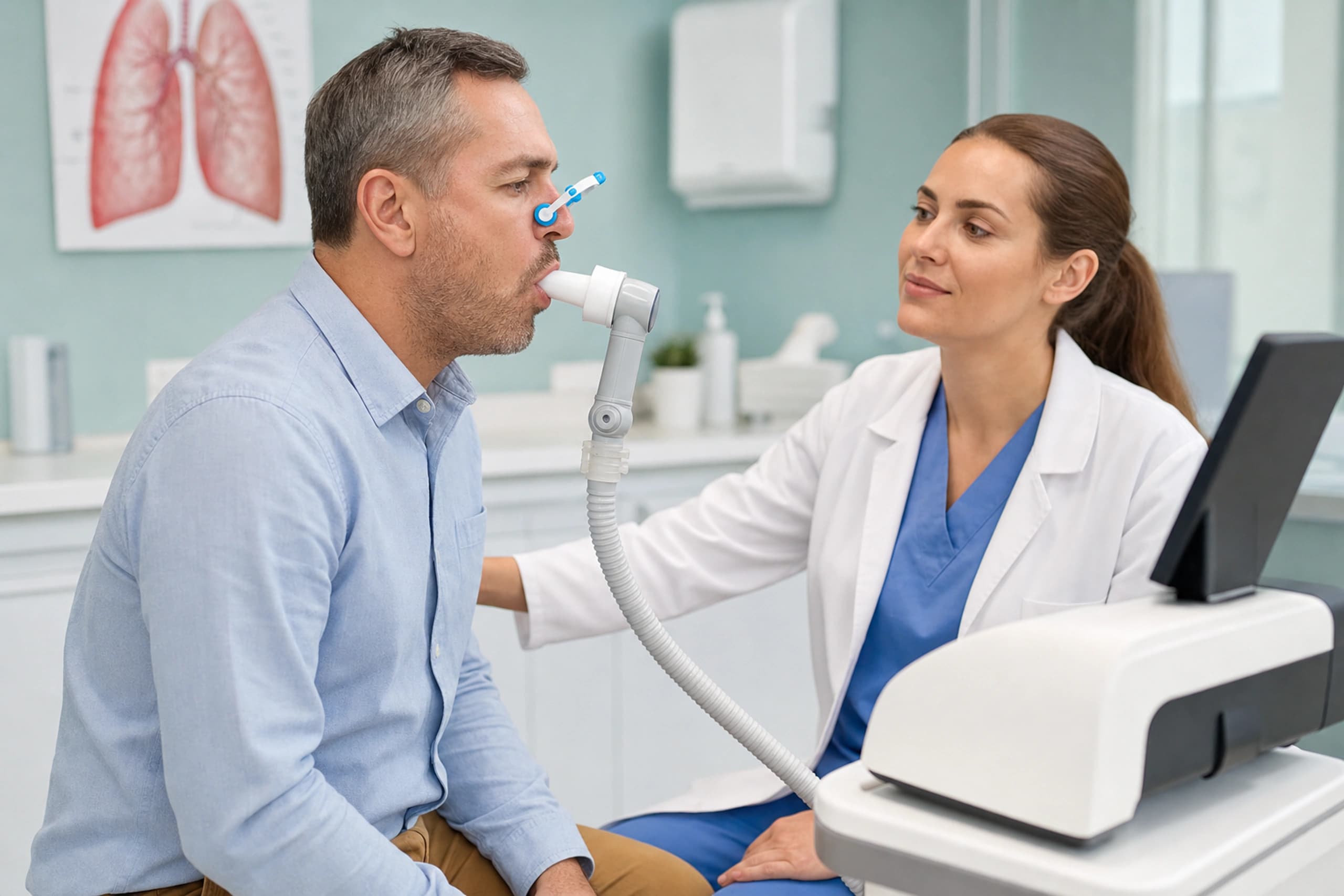
You will usually sit upright, wear a nose clip, and breathe through a mouthpiece connected to the spirometer. After taking a full breath in, you blow out as hard and as completely as possible according to the instructions. The manoeuvre is repeated so the results are reproducible and technically acceptable.
The test does not hurt, although the effort can briefly cause cough, light-headedness, or tiredness. Tell the clinician immediately if you feel unwell. Good coaching and effort matter because an incomplete manoeuvre may produce values that do not accurately reflect lung function.
How is the result explained?
The result should be interpreted in clinical context, not from an isolated percentage. The clinician may explain whether the values are within the expected range, whether an obstructive pattern is present, and whether further investigation, treatment, or monitoring is appropriate.
Where can you have spirometry in Arad?
Dr. Teaha Cristina provides consultations and respiratory investigations in Arad and Chișineu Criș. Review the Arad practice, pulmonology services, or use online booking.
Medical sources
- American Thoracic Society patient information on pulmonary function tests
- ATS/ERS Standardization of Spirometry 2019 Update
Last editorial update: 17 July 2026.
Book appointment